Every electronics project uses resistors. They are the most fundamental passive component — yet many beginners treat them as mysterious striped cylinders they grab from a parts bin and hope for the best. This guide will teach you exactly how resistors work, how to read their values, and how to pick the right one for any circuit.
What Does a Resistor Do?
A resistor opposes the flow of electric current. Think of it like a narrow section in a water pipe — it restricts how much water (current) can flow through. The narrower the pipe (higher resistance), the less water gets through.
Resistance is measured in ohms (Ω). Common prefixes you will encounter:
| Symbol | Name | Value | Example |
|---|---|---|---|
| Ω | Ohm | 1 | 1Ω wire-wound for current sensing |
| kΩ | Kilohm | 1,000 | 10kΩ pull-up resistor |
| MΩ | Megohm | 1,000,000 | 1MΩ in high-impedance circuits |
Ohm's Law: The Foundation
The relationship between voltage (V), current (I), and resistance (R) is:
V = I × R
I = V / R
R = V / I
Example: An LED needs 20mA of current and has a 2V forward voltage. Your power supply is 5V. What resistor do you need?
R = (5V - 2V) / 0.020A = 150Ω
This single formula will solve 90% of your "which resistor?" questions.
Reading Resistor Color Codes
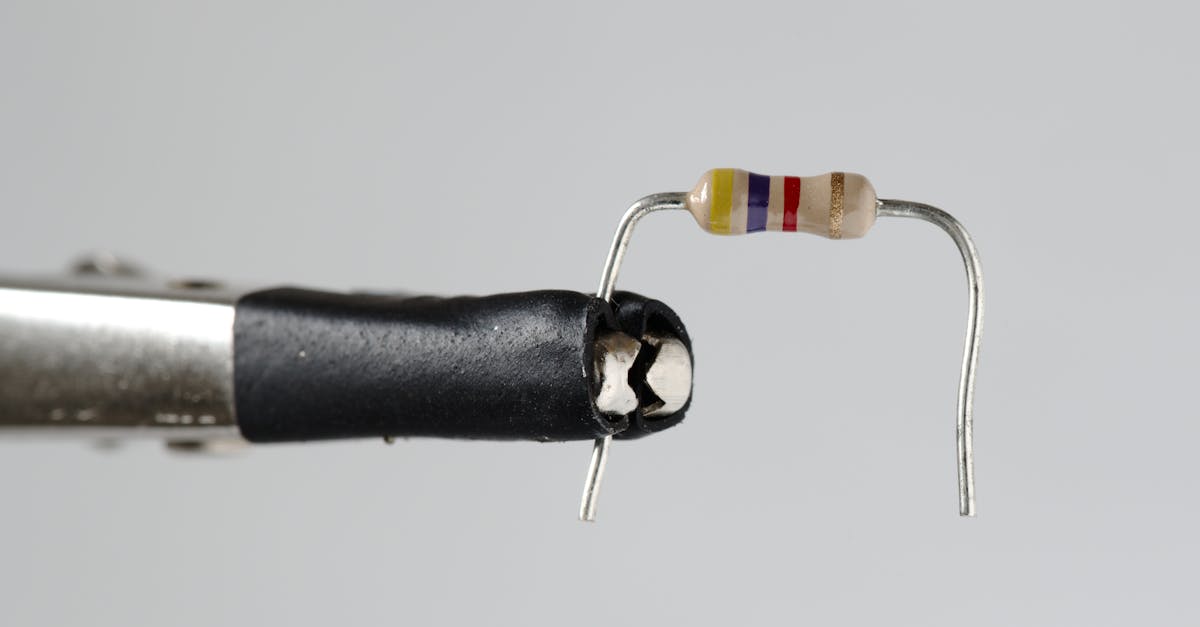
Most through-hole resistors use colored bands to indicate their value. This is the skill every maker must learn.
4-Band Resistors (Most Common)
| Band | Meaning |
|---|---|
| Band 1 | First digit |
| Band 2 | Second digit |
| Band 3 | Multiplier (number of zeros) |
| Band 4 | Tolerance |
Color Values
| Color | Digit | Multiplier | Tolerance |
|---|---|---|---|
| Black | 0 | ×1 | — |
| Brown | 1 | ×10 | ±1% |
| Red | 2 | ×100 | ±2% |
| Orange | 3 | ×1,000 | — |
| Yellow | 4 | ×10,000 | — |
| Green | 5 | ×100,000 | ±0.5% |
| Blue | 6 | ×1,000,000 | ±0.25% |
| Violet | 7 | ×10,000,000 | ±0.1% |
| Grey | 8 | — | ±0.05% |
| White | 9 | — | — |
| Gold | — | ×0.1 | ±5% |
| Silver | — | ×0.01 | ±10% |
Mnemonic: Black Bears Roam Over Young Grassy Bright Valley Grounds Waving (the first letter of each color matches the digit 0-9).
Reading Examples
Brown-Black-Red-Gold = 1, 0, ×100, ±5% = 1,000Ω = 1kΩ (±5%)
Red-Violet-Orange-Gold = 2, 7, ×1,000, ±5% = 27,000Ω = 27kΩ (±5%)
Yellow-Violet-Brown-Gold = 4, 7, ×10, ±5% = 470Ω (±5%)
5-Band Resistors (Precision)
5-band resistors add a third digit for more precision:
| Band | Meaning |
|---|---|
| Band 1 | First digit |
| Band 2 | Second digit |
| Band 3 | Third digit |
| Band 4 | Multiplier |
| Band 5 | Tolerance |
Brown-Black-Black-Brown-Brown = 1, 0, 0, ×10, ±1% = 1,000Ω = 1kΩ (±1%)
SMD Resistor Codes
Surface mount resistors use a printed number code instead of colors:
- 3-digit: First two digits are the value, third is the multiplier. 472 = 47 × 10² = 4,700Ω = 4.7kΩ
- 4-digit: First three digits are the value, fourth is multiplier. 4702 = 470 × 10² = 47kΩ
- R notation: The R indicates a decimal point. 4R7 = 4.7Ω, R47 = 0.47Ω
Types of Resistors
Not all resistors are equal. Different types suit different applications.
Carbon Film
The cheapest and most common type for hobbyist projects. Carbon film deposited on a ceramic cylinder, then laser-trimmed to value.
- Tolerance: ±5% (gold band)
- Power rating: Typically 1/4W (0.25W)
- Temperature coefficient: ~-200 to -500 ppm/°C
- Best for: General prototyping, LED current limiting, pull-ups/pull-downs
- Price: ₹1-2 per piece
Metal Film
More precise than carbon film. A thin metal alloy film on ceramic.
- Tolerance: ±1% (brown band) or better
- Power rating: 1/4W to 1/2W
- Temperature coefficient: ~±50 ppm/°C
- Best for: Analog circuits, precision voltage dividers, audio
- Price: ₹2-5 per piece
Wire-Wound
A resistive wire (nichrome) wound around a core. Used for high-power applications.
- Tolerance: ±1% to ±5%
- Power rating: 1W to 50W+ (large ceramic body)
- Best for: Power supplies, motor braking, dummy loads, current sensing
- Price: ₹10-50+ per piece
- Note: Has significant inductance — not suitable for high-frequency circuits
SMD (Surface Mount)
Tiny rectangular packages soldered directly to PCB pads. Standard sizes:
| Package | Size (mm) | Power |
|---|---|---|
| 0201 | 0.6 × 0.3 | 1/20W |
| 0402 | 1.0 × 0.5 | 1/16W |
| 0603 | 1.6 × 0.8 | 1/10W |
| 0805 | 2.0 × 1.25 | 1/8W |
| 1206 | 3.2 × 1.6 | 1/4W |
For hand soldering, 0805 and 1206 are manageable. Anything smaller requires tweezers, flux, and good magnification.
Potentiometers (Variable Resistors)
Adjustable resistors with a knob or slider. Three terminals: two ends of the resistive element and a wiper that moves along it.
- Linear taper (B): Resistance changes proportionally to rotation. Use for voltage dividers, sensor calibration.
- Logarithmic taper (A): Resistance changes logarithmically. Use for audio volume controls (matches human hearing perception).
Common values: 1kΩ, 10kΩ, 50kΩ, 100kΩ. Trimpots (small, screwdriver-adjusted) are used on PCBs for calibration.
The E-Series: Why Resistor Values Seem Random
You cannot buy a 150Ω and a 160Ω resistor. Standard resistor values follow the E-series — a logarithmic scale that divides each decade into a fixed number of steps.
| Series | Steps per decade | Tolerance | Example values in 100-1000Ω |
|---|---|---|---|
| E6 | 6 | ±20% | 100, 150, 220, 330, 470, 680 |
| E12 | 12 | ±10% | 100, 120, 150, 180, 220, 270, 330, 390, 470, 560, 680, 820 |
| E24 | 24 | ±5% | All E12 values plus 110, 130, 160, 200, 240, 300, 360, 430, 510, 620, 750, 910 |
| E96 | 96 | ±1% | Almost any value you need |
The most common values you will use: 100Ω, 220Ω, 330Ω, 470Ω, 1kΩ, 2.2kΩ, 4.7kΩ, 10kΩ, 47kΩ, 100kΩ.
Power Rating: Don't Burn Your Resistors
Every resistor has a maximum power it can dissipate as heat before it fails. Power dissipation is calculated as:
P = V² / R or P = I² × R
Example: A 100Ω resistor carrying 80mA dissipates:
P = (0.080)² × 100 = 0.64W
A standard 1/4W resistor would overheat and fail. You need at least a 1W resistor, and good practice says to derate by 50% — so use a 2W resistor.
Power Ratings by Size
| Type | Common Rating |
|---|---|
| 1/8W (0805 SMD) | Low-current signal circuits |
| 1/4W (standard through-hole) | Most hobbyist circuits |
| 1/2W | LED strings, slightly higher current |
| 1W-5W | Power supply circuits, motor limiting |
| 5W-50W | Dummy loads, braking resistors, heaters |
Rule of thumb: Always choose a resistor rated for at least twice the calculated power dissipation.
Common Resistor Applications
1. LED Current Limiting
The most common use for beginners. Every LED needs a resistor to prevent it from drawing too much current and burning out.
R = (V_supply - V_LED) / I_LED
| LED Color | Typical V_forward | Current | Resistor (5V supply) | Resistor (3.3V supply) |
|---|---|---|---|---|
| Red | 1.8V | 20mA | 160Ω → use 180Ω | 75Ω → use 82Ω |
| Green | 2.2V | 20mA | 140Ω → use 150Ω | 56Ω → use 56Ω |
| Blue/White | 3.0V | 20mA | 100Ω | 15Ω → use 22Ω |
For ESP32 GPIO (3.3V, max 12mA per pin), use 220Ω for any LED color — it's safe and the LED will be bright enough.
2. Pull-Up and Pull-Down Resistors
These ensure a GPIO pin reads a definite HIGH or LOW when no signal is actively driving it.
- Pull-up: Connects pin to VCC through a resistor. Pin reads HIGH when idle, LOW when button connects to GND.
- Pull-down: Connects pin to GND through a resistor. Pin reads LOW when idle, HIGH when button connects to VCC.
Standard value: 10kΩ. This is the universal default for pull-up/pull-down resistors.
// Arduino with external 10k pull-up
pinMode(2, INPUT);  // External pull-up resistor to 5V

// Arduino using internal pull-up (no external resistor needed)
pinMode(2, INPUT_PULLUP);
The ESP32 has built-in pull-up and pull-down resistors (~45kΩ), but external resistors (10kΩ) give more reliable readings in noisy environments.
3. Voltage Dividers
Two resistors in series create a lower voltage from a higher source. Essential for reading analog sensors, battery monitoring, and level shifting.
V_out = V_in × (R2 / (R1 + R2))
Example: Reading a 12V battery with ESP32's 3.3V ADC:
Using R1 = 27kΩ, R2 = 10kΩ:
V_out = 12V × (10k / (27k + 10k)) = 12 × 0.27 = 3.24V ✓
Important: The total resistance (R1 + R2) should be high enough to avoid draining the source. For battery monitoring, 37kΩ total draws only 0.3mA — acceptable for most batteries.
4. RC Timing Circuits
A resistor and capacitor together create a time delay:
τ = R × C
Where τ (tau) is the time constant — the time for the voltage to reach ~63% of the final value. After 5τ, the capacitor is ~99% charged.
Example: A 10kΩ resistor with a 100µF capacitor:
τ = 10,000 × 0.0001 = 1 second
This is used in debounce circuits, simple timers, and audio filters.
5. Current Sensing
A low-value resistor (0.1Ω to 1Ω) placed in series with a load creates a small voltage proportional to the current flowing through it:
V_sense = I_load × R_sense
This voltage is measured by an ADC or comparator to monitor current. The INA219 module uses this principle for precision current measurement, but you can do it with a simple resistor and the ESP32's ADC for rough measurements.
Resistors in Series and Parallel
Series (Values Add)
R_total = R1 + R2 + R3 + ...
Use case: You need 1.5kΩ but only have 1kΩ and 470Ω. Series gives you 1,470Ω — close enough.
Parallel (Reciprocals Add)
1/R_total = 1/R1 + 1/R2 + ...
For two resistors: R_total = (R1 × R2) / (R1 + R2)
Use case: You need 5kΩ but only have 10kΩ. Two 10kΩ in parallel gives you exactly 5kΩ.
Quick trick: Two identical resistors in parallel give half the value. Three give one-third.
Measuring Resistors with a Multimeter
If color bands are faded or you want to verify:
- Set your multimeter (like the UT890D+) to the resistance mode (Ω symbol)
- Touch the probes to both ends of the resistor
- Read the value — the auto-ranging feature will select the right scale
Important: Never measure resistance in a circuit with power applied. Remove the resistor or at least disconnect one lead, otherwise you will measure the parallel combination of all paths in the circuit.
Common Mistakes
Using the Wrong Value
A resistor 10× too high means your LED barely glows. A resistor 10× too low means your LED burns out or your GPIO pin sources too much current. Always calculate, do not guess.
Ignoring Power Rating
A 1/4W resistor dropping 5V across 10Ω dissipates 2.5W — it will get scorching hot and fail. Check your power dissipation.
Forgetting Pull-Ups on I2C
I2C buses need pull-up resistors (typically 4.7kΩ) on both SDA and SCL lines. Many breakout boards include them, but if you are connecting multiple boards, you might end up with parallel pull-ups that are too strong. Check your module documentation.
Wrong Tolerance for the Application
A ±5% resistor in a precision voltage reference will give inconsistent results. Use ±1% (metal film) for analog circuits, ADC reference dividers, and calibration circuits.
Not Accounting for Temperature
Resistors change value with temperature. Carbon film resistors can drift by several percent in hot environments. For outdoor Indian deployments where temperatures can hit 45°C+, use metal film resistors with low temperature coefficients.
Building a Resistor Kit
Every workbench should have a basic resistor assortment. Here is a recommended starter kit:
| Value | Quantity | Primary Use |
|---|---|---|
| 100Ω | 20 | LED limiting (high brightness) |
| 220Ω | 30 | LED limiting (standard, ESP32-safe) |
| 330Ω | 20 | LED limiting (3.3V systems) |
| 470Ω | 20 | General signal limiting |
| 1kΩ | 30 | General purpose, base resistors |
| 2.2kΩ | 20 | I2C pull-ups (fast mode) |
| 4.7kΩ | 30 | I2C pull-ups (standard) |
| 10kΩ | 50 | Pull-ups, pull-downs, dividers |
| 47kΩ | 20 | High-impedance circuits |
| 100kΩ | 20 | Very high impedance, analog filters |
Total: ~250 resistors. A pre-sorted kit with these values (plus extras) typically costs ₹150-300 from Wavtron and will last you through dozens of projects.
Quick Reference: Which Resistor Do I Need?
| Application | Recommended Value | Why |
|---|---|---|
| LED + Arduino (5V) | 220Ω | ~15mA, safe for GPIO |
| LED + ESP32 (3.3V) | 220Ω | ~6mA, safe and visible |
| I2C pull-up | 4.7kΩ | Standard for 100kHz I2C |
| Button pull-up/down | 10kΩ | Universal default |
| Voltage divider (battery) | 27kΩ + 10kΩ | 12V → 3.24V for ESP32 ADC |
| Base resistor (NPN transistor) | 1kΩ | Limits base current to ~3mA |
| Gate resistor (MOSFET) | 100-220Ω | Prevents oscillation |
| Current sense (1A) | 0.1Ω 1W | 100mV drop, low power waste |
Conclusion
Resistors are simple components but choosing the right value, type, and power rating is what separates a working circuit from a smoking one. Master Ohm's Law, learn to read color codes, and keep a well-stocked assortment on your bench.
With just a handful of values — 220Ω, 1kΩ, 4.7kΩ, and 10kΩ — you can handle the vast majority of hobbyist projects. As your circuits grow more complex, precision metal film resistors and purpose-specific values will become your tools of choice.
Browse the full range of resistors, components, and maker supplies at wavtron.in. All orders ship same-day from Bengaluru with GST invoicing available.